From Handsworth to Chengdu
I first saw Benjamin Zephaniah perform in 1978, in a small community centre in a town called Handsworth, in the city of Birmingham, England. I was a student in Birmingham and I was desperate to engage with some British culture, so a friend recommend that I go and listen to a Caribbean poet. I was quite excited. I had studied English Literature in China, and I had experienced a couple of poetry reading in England, but I feel asleep in both of them. Caribbean poetry was new to me. At first I was excited, but then I began to get worried. A couple of days before the reading another friend warned me that Handsworth was one of the most dangerous places in England, he told me that it was a place where no young, (as I was then), Chinese girl would go alone, and he tried to convince me not to go. But I went, and I went alone. I arrived at the community centre to find that what was actually happening was a reggae dance night; the hall must have contained a thousand people, who didn’t threaten me at all. When I studied English I was taught that ‘Hello’ was the most common greeting used, but here no one said hello, they said ‘hail’, ‘Rastafari’, ‘peace sister’, ‘love sister’, or ‘Let Jah (God) be with you’, and other very welcoming greetings. Most of the people were Caribbean, some were India and Pakistani, but I was the only Chinese person, still this was 1978 and I was used to this. The music was loud, the bass vibrated through every part of my body, and I was finding it a little hard to take. I was considering asking someone if Benjamin Zephaniah was really going to perform, when the music stopped and he appeared, with no introduction, on a makeshift stage. Everyone in the hall began to pay attention to what the poet had to say, and he had a lot to say. At this time there were uprisings all over Britain, South Africa, Zimbabwe, and Northern Ireland and most of his poems were addressing these struggles. He was angry, but articulate, quick, but very understandable, and the audience response was like nothing I had ever seen before, certainly not for a poet. After the performance I felt as if I had seen a whole band on stage, and read a whole book at the same time. The energy, and his presence stayed with me for the rest of the night.
Handsworth was where Zephaniah began to make a name for himself. When he wasn’t doing straight poetry you would find him ‘toasting’ on various sound systems in the area. Toasting was an early form of rap, but rap that was related to reggae music rather than Hip Hop music; it was about entertaining the crowd and chanting words of wisdom. Zephaniah did all this, but he also became known for his social commentary. He started performing poetry in the school playground when he was 6 years old, his first real public performance was in church when he was 11 years old, but when he started on the sound systems his ability to comment on the world became apparent.
His poetry had an unusual mixture of anger and humour, it was intellectual, but accessible, and this began to connect with people who would never normal listen to poetry. Soon he started to concentrate on performing without music, but even then the poetry kept its musical qualities. After performing in the Reggae clubs and the community centres of Birmingham he felt that he needed to connect with people outside his city so he headed south, to London.
It was 1979, and a couple of days after arriving in London Zephaniah was attacked by a group of racist. They were members of the National Front, a racist organisation who’s declared aim was to keep Britain white. Zephaniah had been racially abused before, but after this attack he wrote the poem ‘Fight Dem’, a poem written as a call to the white working class to wake up, united with black people, and confront the real enemy. Although the poem had not been written down it became a big hit in London, a city that was full of protests at the time. This was true of many of his poems. Dis Policeman Keeps On Kicking me to death was an anthem, and at performances hundreds of people would chant along with him as he performed it, a long time before it was written down. This was due to a loyal young following that would really follow him, and learn the poems by heart. Each weekend London would see demonstrations against unemployment, racism, apartheid, sexism, the arms trade, and animal cruelty. These demonstrations were perfect platforms for his poetry.
His first book of poetry was called Pen Rhythm and was published by Page One Books, a small east London based publishing co-operative that was keen on publishing poets who were rooted in their communities. They published Zephaniah when other publishers failed to tune into the new poetry that was about to emerge. I went to London for the launch of the book and met him, and spoke to him for the first time. For an independently published book it sold well, going into 3 editions, but it didn’t really capture the force of his performances. His real strength was in performance, it was here that the Dub (Reggae) Poet would cause a revolution, a revolution that injected new life into the British poetry scene and attracted the interest of many mainstream publishers, many of whom had sent refusal letters to him only 12 months earlier. When you look around London and other major cites of Britain now you will find that most of them have a performance poetry, or spoken word scene. When Zephaniah started there was none. It was he, along with poets like Jean Breeze, John Cooper Clarke, Linton Kewsi Johnson and others that created the spoken word culture in Britain that there is today.
I saw Zephaniah again in the Eighties, this time he was performing at a political rally, a Rock Against Racism concert. As well as speeches from people like Tony Benn, Tariq Ali, and other prominent political figures, there were Punk bands like Sham 69, The Ruts, The Clash, and reggae bands Misty In Roots, Aswad, and Mikey Dread. It was here that I first saw the true awesome power of Zephaniah’s poetry on a grand scale. Although he was the only solo artist the audience gave him the respect of a full band, and I remember thinking that he actually filled the stage more than the bands did that night, going from one corner to another, dancing to the music that he created with his words. On that night, for the first time in my life, I saw people in the audience dancing to nothing but words.
I returned to China in 1990, just after the release of the Us An Dem album. It was an album that I didn’t like very much. It was too funky for me. I thought he had strayed too far from his reggae roots. So did a lot of his followers, or his sympathizers, as he calls them. The album was appreciated more in the USA than in the UK, and one track ‘Everybody Have a Gun’ was a surprise hit in Jamaica. But it did show that he was willing to experiment, in fact there is no Benjamin Zephaniah album that is like another, and although he has been a constant on the reggae and dub scene, he has always been a maverick, an individual, a non conformist, and hard to categorise. In fact his first album called Rasta was recorded a long time before the term world music was being used, but it was a reggae album that feature an oboe, a sitar, a mandolin, African drummers, and African and Chinese flutes. It is therefore understandable that his many collaborations have been so varied. Kinobe, Sinead O’Connor, Back to Base, Swayak, Dubioza Kolektiv, Toddla T, Asian Dub Foundation, and The Imagined Village have all called upon his poetry, and it was because of his originality, and his message that the Wailers chose to work with him after Bob Marley left this earth. This is a collaboration that should not be underestimated. It was a tribute to Nelson Mandela, who said it was a great inspiration to him when he was incarcerated in Robben Island Prison. At the time there were hundreds of singers trying to fill Bob Marley’s space. Zephaniah was chosen because he didn’t want to fill this space.
I once followed him, with Miriam Makeba, on tour with his band around Europe and the Caribbean, and I really began to appreciate how far he had come and how hard he worked. He was now an established performance poet, a musician, a television presenter, playwright, and a political commentator. I saw him perform at Berlin in the night, wake up the next morning, and when the band went on to the next city he would fly back to London, present a TV programme, do an interview and fly back. He would go from the airport and walk straight on stage, performing like a man refreshed. I have seen him perform on a Caribbean island in the night, and go to perform in a school in Miami in the day.
I had not seen him for many years then in May 2011 he came to tour China. This was something I thought I would never see, the original rasta Dub Poet, dubbing it in China. The tour saw him performing solo in schools, clubs and bookshops. He was now also a novelist and a professor. He didn’t look very different from how he looked in 1978, and his passion for poetry and the issues he cared about had not diminished at all, if anything he seemed more fired up than ever. I was keen to see how Chinese audiences would take to his dub poetry and I was amazed to see how easy he connected with them. Over a two month period he performed in kindergartens, schools, dance clubs, universities, and two hospitals. He was able to converse with intellectuals and street vendors with ease, and when it came to expressing his ideas his ability to communicate complex ideas in a direct uncomplicated way, without talking down, or talking up to people, won him admirers wherever we went. At a performance in Chengdu, a woman who had just been blessed with a conversation with him told me that she thought he was the most approachable star in the universe.
Zephaniah is a one off. He seeks no prizes, doesn’t much like awards, and is suspicious of authority. He has never had a person or team promoting him, his popularity has come from the people he has inspired. His unselfishness and willingness to share his experiences with others, and help up-and-coming poets is legendary. I have watched him over the years and I have never failed to be amazed by what this human being is able to with words. In Jamaica they call him a dub poet, in Africa they call him a griot, in China he is Da Ben, the shi ren.
Liu Chen Shui Bo (2012. Zigong, China)
Dreadlocks ina India
RANGA Shankara, Bangalore. March 17 2007. Benjamin Zephaniah, the charismatic British performance poet, is on stage. A banner backdrop cues us in to him: “Poet. Prophet. Activist.”
The dreadlocked Rastafarian of Jamaican origin offers dramatic poetry that seethes with politics. Every word connects with his concerns – the Iraq war, animal rights, the body beautiful and macho men, race, class and gender. Most deeply, a quest for co-existence and love for Planet Earth. In a trice, we all bond with him. No wonder he has been one of the British Council’s most popular cultural ambassadors since the 1980s, equally beloved in China and India, Fiji or Argentina, South Africa or Australia. Or even at schools across Britain.
On his twelfth Indian visit and fourth tour, Zephaniah touches Mumbai, Pune, Ahmedabad, Chennai and Kolkata, en route to Sri Lanka. He shies away from Queen’s English and pucca public school conformism. He celebrates the spoken word, the lively language of the British streets. What the spotlight misses is the secret Zephaniah. The one who learnt kalaripayittu near Kochi or is moved to tears because a feral cat in an English garden is put to sleep because it isn’t a pet!
Zephaniah was shortlisted for a fellowship at Cambridge University, and later for Oxford Professor of Poetry. His poem, “The London Breed,” has found a place of honour in the British Museum: “I love this concrete jungle still/ with all its sirens and its speed/ the people here united will create a kind of London breed.”
His journey to reluctant celebrity has been long and hard. A troubled childhood, dealing with a violent father in Handsworth, “the English capital of Jamaica.” Dropping out of school at 13, learning to read and write at night school at 21. “I got my education from travelling, from talking to people, debating and asking questions about their society. That really excites me. All these observations about life make fascinating poetry,” Zephaniah says.
A far cry from Shakespeare or Shelley, who figure on his icon list, Zephaniah is “an equal opportunities poet.” His working class poetry is attuned to slavery, racism, bigotry, and every possible battle for justice.
What triggered his creativity? “I just love playing with words. When I heard people talking, I didn’t just hear the words, I heard the rhythm. I was surprised one day when somebody told me it was poetry. I didn’t know there was a word for it! My mother says I started doing poetry when I was about five years old, as soon as I was able to put words together,” Zephaniah recalls in an interview in Bangalore.
Taking in the current British performance poetry scene, embracing Asians, gays and lesbians alike, Zephaniah adds, “I create poetry to reach people, whether they are kids sleeping on the streets of Kolkata or those attending a literary seminar at Cambridge. Or friends from Jalandhar, who don’t even know I’m a poet. I play football with the kids there.”
He has vivid memories of poetic activism, though. Of reciting ‘Free South Africa’ at a rally in Trafalgar Square in front of South Africa House. It became a rallying cry against apartheid. “When another unpublished poem was chanted back to me by thousands of people, I remember thinking: It’s been published in their hearts. That’s the kind of publishing I’m interested in,” Zephaniah adds.
Yet, he has made the grade as a published poet including The Dread Affair (1985), Inna Liverpool (1990), Rasta Time in Palestine (1991), City Psalms (1992), Propa Propaganda (1996), and Too Black, Too Strong (2001). The exuberant non-conformist has edited The Bloomsbury Book of Love Poems (1999), and written three novels for teenagers.
Can an artist today be apolitical? “I think you could, but you’d be doing your art a disservice,” responds Zephaniah. “If there’s a platform available, black people would make a statement. Writing about the personal is probably what I haven’t done as much as I should have done. I feel people in Iraq or Sri Lanka are more important than me.”
What sets his poetry apart? Paraphrasing Nobel laureate Derek Walcott, the globe-trotter says, “When we Caribbean poets write, we always write with a voice in our heads. When we put it on the page, we’re trying to capture that voice. I think he extended that to Asian writers as well. It’s a poetry of sound. When you read it, I want you to hear it.”
A poet who is recognized in British TV studios, hotels or brand outlets, Zephaniah continues to be anti-establishment. He declined an Order of the British Empire (OBE) in 2003. He even has refused to front a British police campaign to recruit a more multicultural force after constant trouble with ‘institutionalized racism.’
Today, with a flat in Beijing, and a country house in Lincolnshire, what makes him tick? “I’ve always been a very independent thinker. I once argued that paganism is the only true world religion,” Zephaniah says. “In the Eighties, I travelled to pilgrimage sites like Jerusalem and Jordan. I came away feeling close to god, but less religious. But I’m still an animal rights hardliner. I still won’t consume or wear anything from an animal. If they’re putting makeup on my face for a TV programme, I check that it’s not animal-tested.”
How does being British fuel his poetry? “I’m living in Britain. I’ve got Jamaican rhythms going around in my head. I’m listening to bhangra music. I practice martial arts like kung-fu. Before we start, we do Chinese chanting, play some Chinese music. I would be a brick if I wasn’t taking in all these influences,” he confesses.
In an introduction to Too Black, Too Strong, Zephaniah wrote, “I live in two places, Britain and the world, and it is my duty to explore the state of justice in both of them… speaking my mind as I go, ranting, praising and criticizing everything that makes me what I am. But this is what Britain can do. It is probably one of the only places that can take an angry, illiterate, uneducated, ex-hustler, rebellious Rastafarian, and give him the opportunity to represent the country.”
That was the gift that Zephaniah bore to us in India. From the Rasta road, with love.
(Originally published in India in The Week magazine, 2007)
“Great Briton talks great sense”
by Ed Barrett for remotegoat on 04/05/12
Even on the raised stage of the grand opulent concert room of St. George’s Hall, renowned poet Benjamin Zephaniah seems down-to-earth and approachable, transparent yet complex. Flirtatious but feminist, he is an openly heterosexual man who joined Amnesty International’s campaign against homophobia in Jamaica; a martial artist who appreciates the fact that the art he follows was created by and for women; an egalitarian who quotes Prince Charles. A man of many parts, then. Confident yet self-effacing, and virtually without referring to his very few notes, he talks about his apparently thorny topic – ‘Multiculturalism or Muscular Liberalism?’ – with such simplicity and common sense, you find yourself wondering how people can see things any other way. That he does so without resorting into dogma, rhetoric or Political cant makes his arguments all the more compelling. Starting with the observation that our Anglo-Saxon heritage is by definition not mono-cultural, and referencing the Jutes, the Celts, and many other tribes beside, his conclusion that to be against multicultural society is to be anti-British is quite simply undeniable. His pleasure at having been brought up amongst people from a variety and cultures is obvious; and his observation that living in a closed culture would be boring brings laughs of recognition from the crowd. On a more serious note, he expresses his opposition to the ruling – or even oppression – of the many by the few with such feeling you get the impression that he takes issues such as female genital mutilation and forced (as distinct from arranged) marriages personally. It comes as no surprise that one anecdote – virtually an aside – sees him becoming a relationship counsellor to friends from the former Yugoslavia whose marriage is fractured by the Serbo-Croat divide.
He tells us he is not proud of being British, nor of being black, because these are things that happened without any effort on his behalf.
Were there more time, it would have been interesting to hear how he believes his favoured political system – anarchy – would work in practice, though there are hints of this being part of a wider philosophy, as is his avowed belief in God but not religion; and I doubt I am alone in wishing we could have heard more of his poetry. But, as the adage goes, you should always leave them wanting more; and I also doubt I am the only person who left feeling uplifted and full of hope.
Ed Barrett
Remote Goat

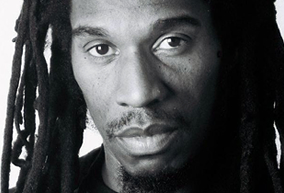
 In the early Eighties when Punks and Rastas were on the streets protesting about SUS Laws, high unemployment, homelessness and the National Front, Zephaniah’s poetry could be heard on the demonstrations, at youth gatherings, outside police stations, and on the dance floor. It was once said of him that he was Britain’s most filmed, photographed, and identifiable poet, this was because of his ability to perform on stage, but most of all on television, bringing Dub Poetry straight into British living rooms. The mission was to take poetry everywhere, he hated the dead image that academia and the establishment had given poetry and proclaimed that he was out to popularise poetry by reaching people who did not read books, those that were keen on books could now witness a book coming to life on the stage. This poetry was political, musical, radical, relevant and on TV.
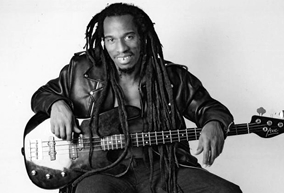 Periodically The Benjamin Zephaniah Band takes to the road, the nature of the modern music business means recordings reach places around the globe a lot quicker than the poet does, and this means that many people around the world are more familiar with the poet’s music than his performances, plays or books. His only official fan club developed in Malawi in Central Africa and his only Number One Hit Record was in the former Yugoslavia where the Rasta LP was released on the Helidon label. He was the first person to record with the Wailers after the death of Bob Marley in a musical tribute to Nelson Mandela. Free South Africa by Benjamin Zephaniah and the Wailers was recorded at Marley’s Tuff Gong Studio in Kingston, Jamaica. Mandela heard the tribute whilst in prison on Robben Island and soon after his release he requested an introductory meeting with Zephaniah, they have now built a relationship which has led to Zephaniah working with children in South African townships and hosting the President’s Two Nation’s Concert at the Royal Albert Hall in July 1996.
 Then there is Benjamin Zephaniah the children’s poet. His first book of poetry for children called Talking Turkeys had to go into an emergency reprint after just 6 weeks, no one could foresee how popular the book would be, it went to the top of the children’s book list and stayed there for months. At first he was not keen on publishing a book for children believing that there was just poetry, not children’s poetry or adult’s poetry, but he was soon convinced that young people did appreciate the fact that he was not afraid to write about the real world where there are bullies, guns, racism and war. Being a passionate vegan he writes a lot about animals but these animals are not all smiley, happy creatures, some may just be waiting for slaughter or losing their habitat, and of course some may be having fun. Then seemingly from nowhere, in 1999 he wrote a groundbreaking novel for teenagers. ‘Face’ the first of four novels to date, proved that teenage boys would read if they have access to books that they can relate to. Zephaniah writes gritty, realistic novels about the lives of teenagers, these novels are directed to adults as much as they are to teenagers. He believes that for the most part teenagers know what they are going through, but adults need reminding, they have short memories.